Recent Semax papers report molecular and functional findings in rats, female mice and cell models. They expand mechanism hypotheses but do not supply the human comparative evidence often implied by broad neuroprotection claims.
Evidence at a glance
- A 2024 rat ischemia study found 3,774 differentially expressed genes after ischemia and partial normalization under two ACTH-like peptides.
- Semax and the comparator condition were associated with 1,539 and 2,066 differentially expressed genes, respectively; 1,171 ischemia-distorted genes were reported as compensated by both.
- A 2025 study used female C57BL/6 mice with experimental spinal-cord injury and proposed an Oprm1/USP18/FTO mechanism.
Study record
The rat paper compared gene-expression profiles 24 hours after transient middle cerebral artery occlusion. Only 32 differentially expressed genes separated the two peptide conditions at that time point, leading the authors to emphasize overall similarity rather than a large head-to-head difference.
Results in context
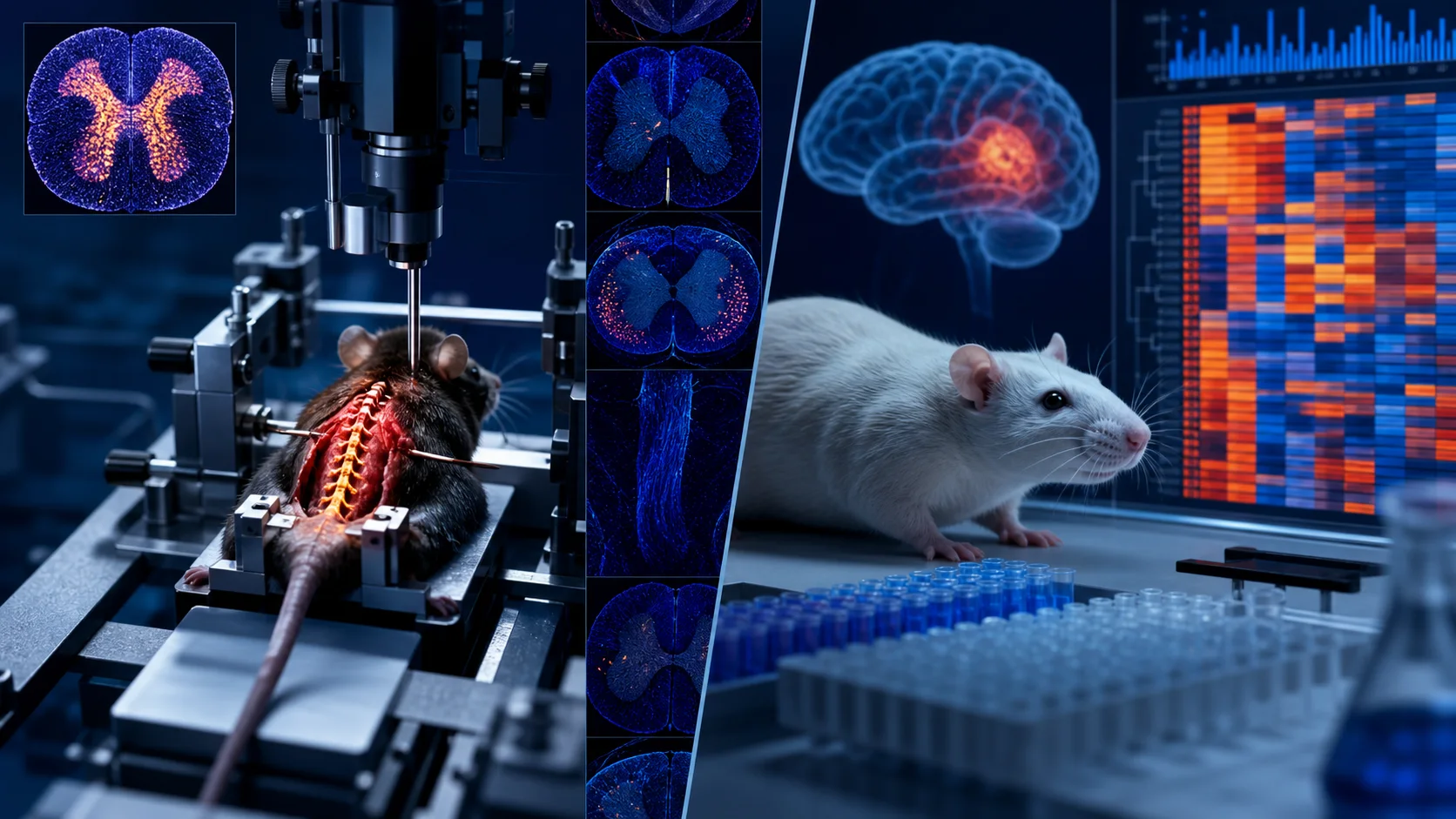
The 2025 spinal-cord paper used locomotor tests, tissue staining, microscopy, RNA sequencing, knockdown experiments, network pharmacology and molecular docking. It connected Semax-associated recovery with μ-opioid-receptor signaling, USP18 and FTO deubiquitination. That multi-method chain remains a preclinical mechanism proposal.
Animal functional recovery, transcriptome normalization and cell-model assays answer different questions. None should be rewritten as established recovery in people, and molecular docking alone is not target validation.
What the evidence cannot establish
Species, injury induction, timing and laboratory endpoints differ from human clinical care.
The 2025 work used female mice; sex and species generalization require direct testing.
These studies do not establish pharmacokinetics, comparative effectiveness or catalog-lot equivalence in humans.
Sources & editorial method
The editorial workflow began with linked PubMed primary papers, systematic reviews, PubChem identity records and FDA/DailyMed regulatory records. Population or model, denominators, endpoints, numerical results, null findings, limitations and conflicts were extracted before drafting. AI-assisted drafting and original image generation were used; the final facts and evidence boundaries were checked against the linked records on 2026-09-02. This is not independent peer review.
3 linked records are listed in the references below. Read the editorial and AI-assistance policy.
How to interpret this article
Source-checked on 2026-09-02. Null results, study size, model/population limits and relevant conflicts are retained. This is not medical advice, a customer case or validation of a catalog lot.
Research-use boundary: Catalog materials discussed on this website are for laboratory research, development and manufacturing use only, not for human or veterinary use. This content is not medical advice and does not provide administration instructions.
Primary records and authoritative sources
- ACTH-like peptides and rat brain gene expression after ischemiaPreclinical study. 2024. PMID 39767736.
- Semax targets Oprm1 in a spinal-cord-injury mouse modelPreclinical study. 2025. PMID 40692165.
- Semax protein-expression study in rat cerebral ischemiaSequence and preclinical context; PMID 34201112.
Continue with structured records
Move from this editorial analysis to the product identity, filtered evidence and controlled terminology behind it.