Lot-document scope confirmed before quotation · Research use only
  • Specification Review
  • Lot Documents on Request
  • Business Support · Xi’an
  • Destination Eligibility Confirmed
西安诺和达生物科技有限公司

ANALYTICAL METHODS · PRACTICAL GUIDE

Why Mass-Spectrum Peaks Form a Cluster: Isotope Spacing and Charge

Read the gaps in a group of isotope peaks to understand charge.

NHD Technical Team3 teaching figuresSources checked: 2026-10-11

Several closely spaced peaks appear in the spectrum. Are they several impurities? They may instead be an isotope cluster from one type of molecule. The spacing can help explain the ion’s charge.

The same element can have slightly different masses

Atoms of the same element can have different numbers of neutrons. These versions are called isotopes. A molecule containing a heavier isotope has a slightly different mass, even when its peptide sequence has not changed.

Peptides contain many atoms, so a sample can give a group of nearby isotope signals rather than a single line. Actual patterns depend on the elements and isotope combinations present.
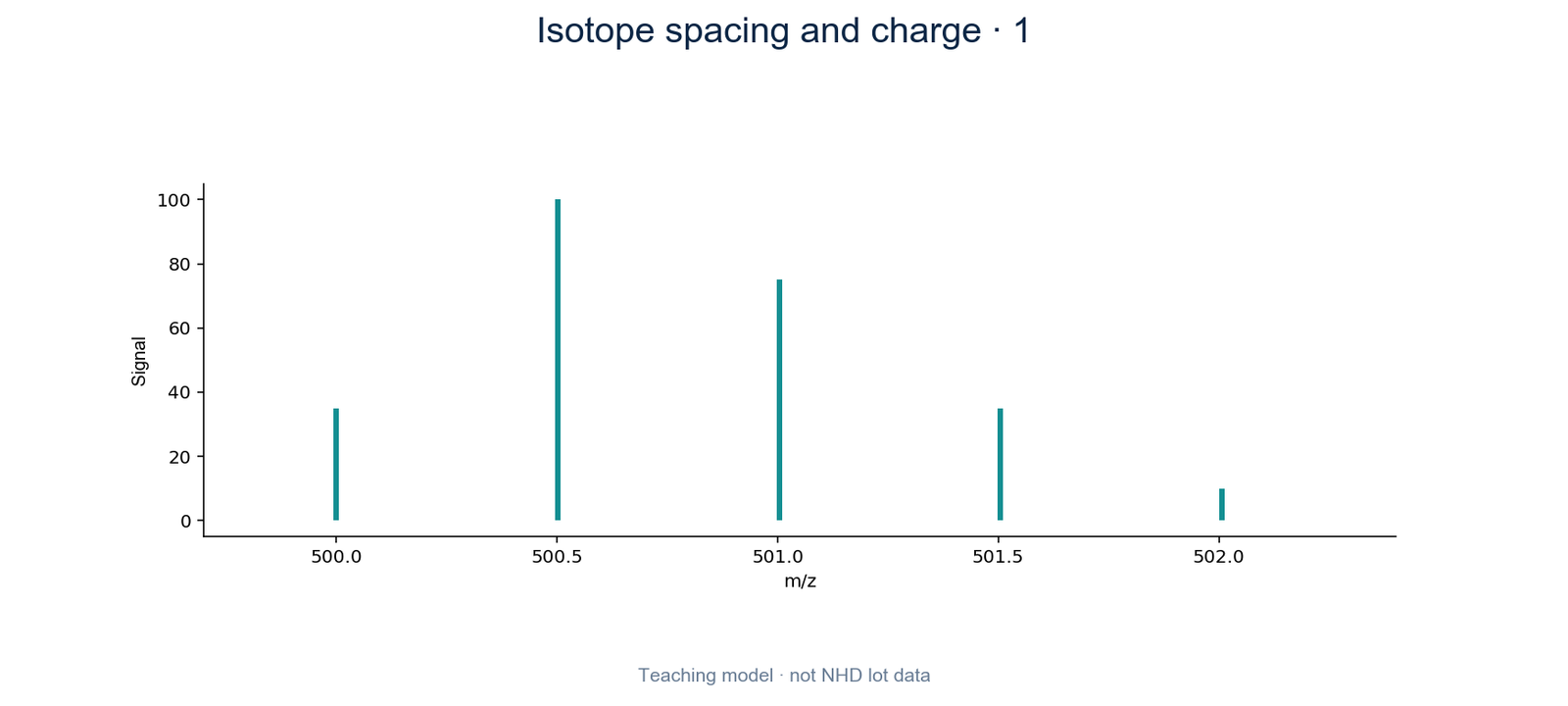
Isotope spacing and charge · 1
Figure 1. A group of isotope peaks need not represent different peptide sequences.

Why more charge squeezes the gaps

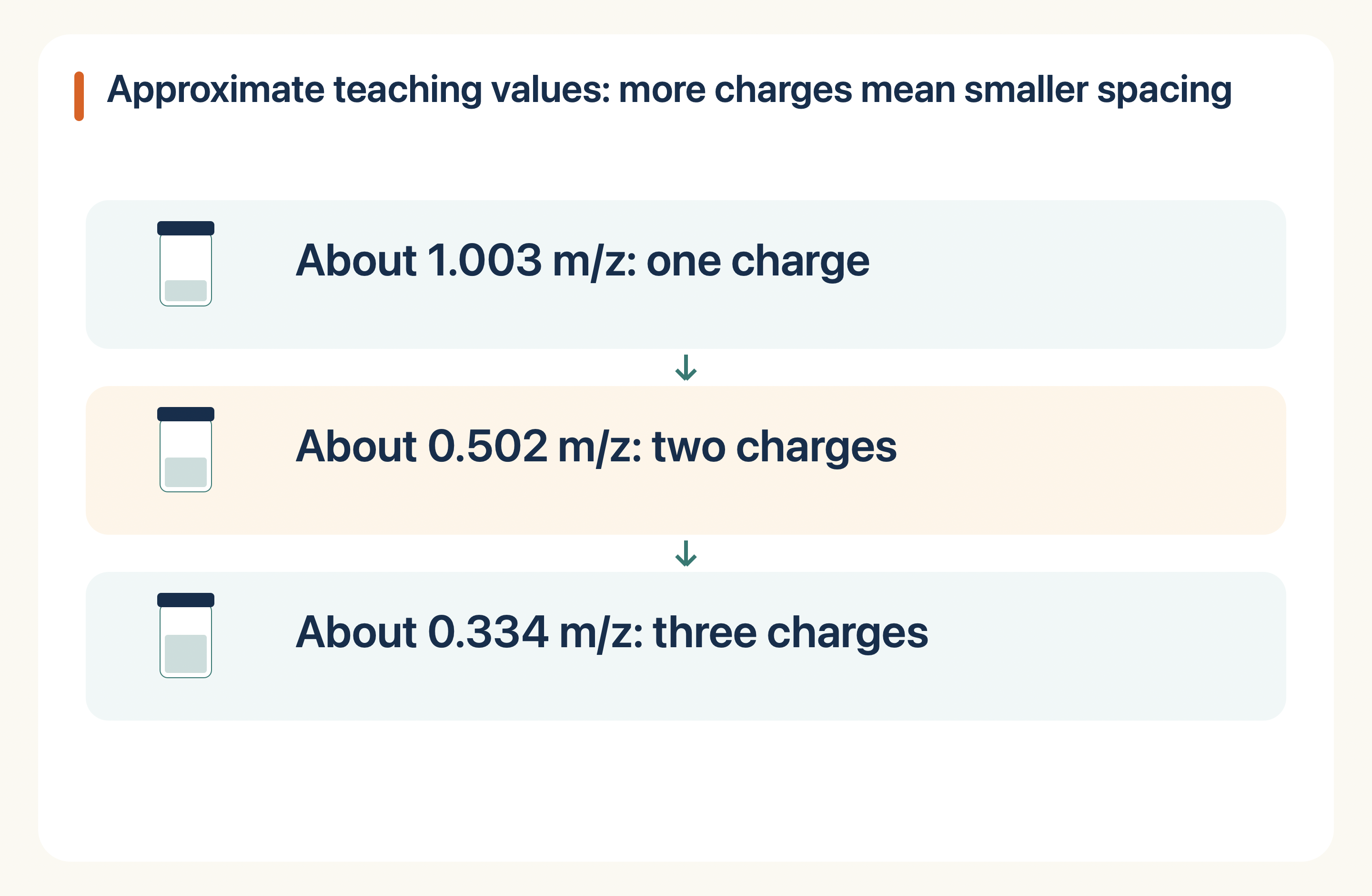
The axis is m/z: ion mass divided by charge. Using a common carbon-isotope spacing approximation of 1.00335 Da, a single-charge group has gaps near 1.00335 m/z. With two charges, the gaps are near 0.50168; with three, near 0.33445.

The mass difference is divided by a larger number. That is why the peaks move closer together on this axis.

Isotope spacing and charge · 2
Figure 2. Approximate gaps for one, two and three charges.

Read the scale, not just the shape

Zoom into a clearly resolved cluster and subtract the positions of adjacent peaks. A gap near 0.50 m/z suggests two charges in this model. A gap near 0.33 suggests three.

This only works if you are comparing peaks from the same cluster. Overlapping clusters or insufficient resolution can make the estimate misleading.

Turn m/z back into molecular mass

Suppose the ion is confirmed as [M+2H]2+ and its m/z is 501.0073. Multiply by two, then subtract the mass of the two added protons: 2 × 501.0073 − 2 × 1.007276 ≈ 1,000.0000 Da.

Spacing helps estimate charge, but does not by itself establish the adduct type. Check the ion formula before using this calculation.

Isotope spacing and charge · 3
Figure 3. For the assigned protonated ion, account for charge and added protons.

Try reading a three-charge cluster

A convincing cluster can help interpret the mass signal. It does not measure peptide activity or establish every position in its sequence.

Adjacent peaks are about 0.334 m/z apart. Which charge is the first possibility in this model?

See the answer

Three charges, provided the peaks belong to one suitably resolved cluster.

Checking MOTS-c and SS-31 plots

For MOTS-c or SS-31 spectra, ask which isotope clusters and charge states support the reported molecular mass. Keep the annotated spectrum with the calculation.

MOTS-c / SS-31

Discuss material and document requirements with NHD · Continue with the analytical guide
Sources and example notes

The numbers and curves are teaching examples, not product-batch test results. Sources checked on 11 October 2026.

AI-assisted writing and source review. Catalog materials are for research, development and manufacturing, not human or veterinary use.

Why does 0.5 m/z isotope spacing suggest two charges?

A cluster of nearby peaks can represent different isotope compositions of one molecule. Charge divides their spacing and helps identify the charge state.

Distinguish the cluster from its neighboring peaks

Adjacent isotope peaks commonly differ by approximately 1.003 Da in mass. A mass spectrum displays mass-to-charge ratio: spacing is about 0.502 m/z for two charges and 0.334 m/z for three. These are approximate teaching values; interpretation needs sufficient resolution.

Spacing of 0.5 does not mean half a molecule

Hypothetical example: a cluster near m/z 501 with spacing around 0.5 suggests two charges. If assigned as [M+2H]2+, neutral monoisotopic mass is approximately 501 × 2 − 2 × 1.0073 = 999.9854 Da. Actual calculation needs the selected peak’s accurate m/z, rather than the rounded value 501.

Approximate teaching values: more charges mean smaller spacing
Teaching schematic. Numbers are hypothetical examples or explicitly identified study conditions described in the text.

Charge is one step in identity assessment

Also check adduct form, other charge states, theoretical isotope distribution and sequence evidence where needed. A plausible cluster spacing does not independently prove a complete sequence or exclude isomers with the same mass.

Original sources and scope

Consult the sources for full methods and results. Teaching examples are not NHD lot-test data.

Related research materials

Ask about materials and documentation

Research materials and experimental education; no instructions for human use.