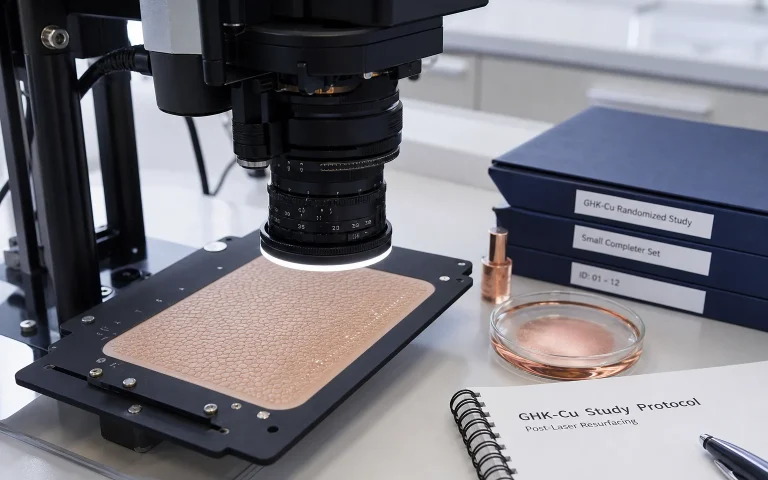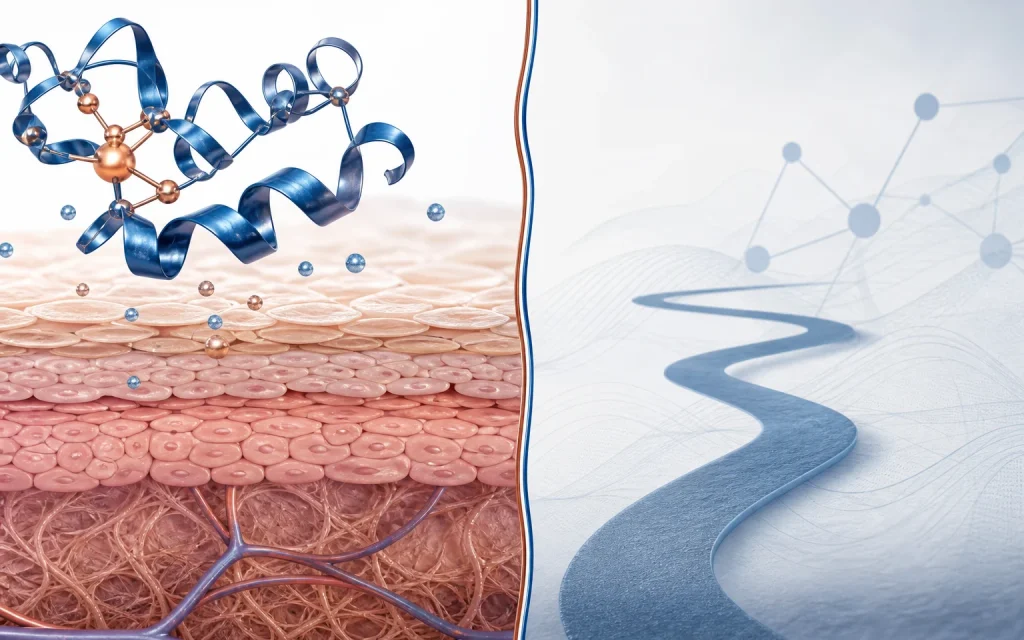
Route is not a footnote in GHK-Cu evidence. A topical skin-care study and an injectable compounded preparation have different exposure, sterility, aggregation and safety questions.
What the record shows
- Do not use a small topical trial to support injectable claims.
- FDA identifies limited human safety data and potential immunogenicity from aggregation or peptide impurities for injectable routes.
- Copper occupancy, peptide identity and quantitative content are separate analytical questions.

The identity and evidence boundary
A chromatogram can show relative components under one method but may not establish copper-to-peptide stoichiometry or total mass fraction. The exact claim should match the test actually performed.
What belongs in the material record
The safest SEO language is route-specific: describe the experiment, formulation and endpoint in the cited paper, then state that those data do not validate other routes or a catalog lot.
Editorial rule
Use the exact intervention name, model, population and endpoint from the cited record. Do not convert an association, mechanism, animal result, approved finished-drug record or analytical test into a claim about an unrelated catalog lot.
Sources & editorial method
The editorial workflow starts with linked peer-reviewed papers, trial registries or regulatory records; extracts the population or model, endpoints, numerical results and limitations; and separates the studied intervention from catalog material. AI-assisted drafting was used to structure the first version. Claims, figures, evidence labels and limitations were checked against the linked records in the site editorial workflow. This is not independent peer review.
5 linked records are listed in the references below. Read the editorial and AI-assistance policy.
How to interpret this article
Source-checked on 2026-08-28. Null findings and study limitations are retained. This is not independent peer review, medical advice, a customer case, or validation of a catalog lot.
Research-use boundary: Catalog materials discussed on this website are for laboratory research, development and manufacturing use only, not for human or veterinary use. This content is not medical advice and does not provide administration instructions.
Primary records and authoritative sources
- Effects of topical copper tripeptide complex on laser-resurfaced skinMiller TR, et al. Archives of Facial Plastic Surgery. 2006. PMID 16847171.
- GHK-Cu wound research in a rat modelPreclinical context; PMID 8227353.
- Certain Bulk Drug Substances That May Present Significant Safety RisksU.S. FDA. Current compounding safety-information page.
- ICH Q2(R2): Validation of Analytical ProceduresOfficial analytical-validation framework; not evidence that a specific catalog lot has been tested.
- ICH Q14: Analytical Procedure DevelopmentOfficial analytical-development framework; included as general method guidance only.
Continue with structured records
Move from this editorial analysis to the product identity, filtered evidence and controlled terminology behind it.