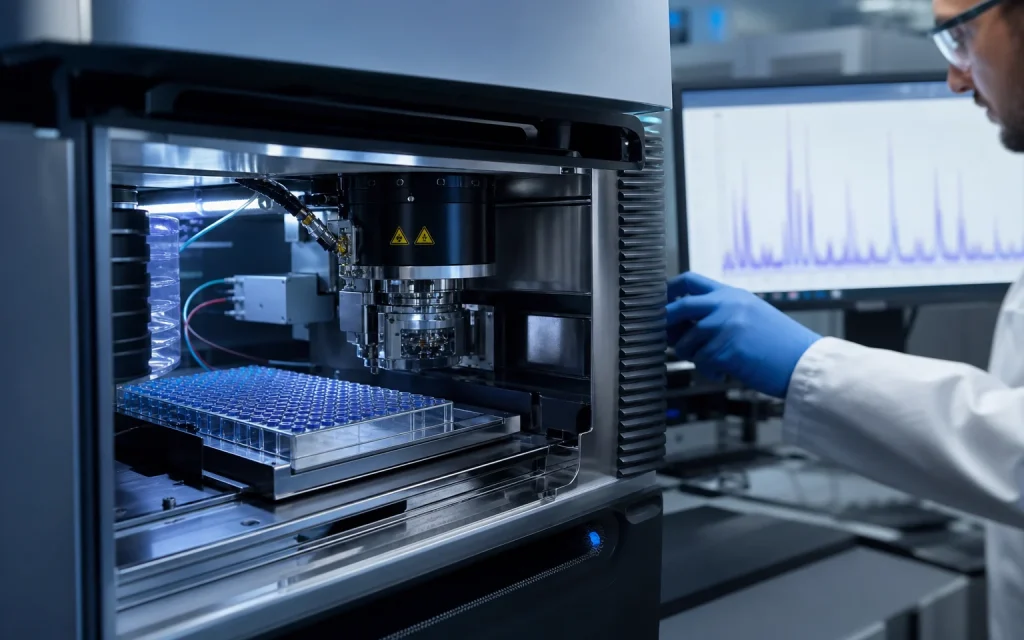
Mass spectrometry can provide powerful peptide identity evidence, but the sentence “mass matches” is incomplete. A useful interpretation asks which ion was measured, how charge states were assigned, whether the neutral mass was deconvoluted correctly, what mass tolerance was used and whether fragment evidence supports the proposed sequence.
ICH Q6B describes mass spectrometry and peptide mapping as complementary characterization tools. FDA’s synthetic-peptide guidance also emphasizes control of peptide-related impurities. The practical lesson is that identity is stronger when orthogonal observations converge, not when a single rounded molecular-weight value is copied into a certificate.
Why a peptide appears at several m/z values
Electrospray ionization commonly produces multiple charge states. The instrument measures mass-to-charge ratio, written m/z, rather than neutral molecular mass directly. A peptide carrying three protons appears at a different m/z than the same molecule carrying four. Software can combine the charge-state envelope into a deconvoluted mass, but the underlying spectrum and charge assignment should remain reviewable.
Adducts, counterions, oxidation, dehydration or other modifications can shift observed ions. The expected ion formula must be stated: average or monoisotopic mass, neutral molecule or protonated ion, and whether terminal modifications are included.
Exact mass narrows the possibilities; it does not prove the order
A high-resolution intact-mass match can rule out many wrong compositions. It still cannot necessarily distinguish leucine from isoleucine, positional isomers or two sequences with the same elemental composition. A sequence permutation can share an intact mass. That is why a mass match supports identity but should not be described as complete sequence confirmation on its own.
| Evidence layer | Useful question | Important limitation |
|---|---|---|
| Intact m/z envelope | Are coherent charge states present? | Adducts and overlapping species can complicate assignment |
| Deconvoluted mass | Does observed neutral mass agree within a stated tolerance? | Isobaric or isomeric structures may remain |
| Isotope envelope | Does fine structure fit the proposed composition? | Resolution and signal quality set the discriminating power |
| MS/MS fragments | Do b/y or other fragment series support sequence regions? | Coverage gaps and ambiguous residues can remain |
| Chromatography + MS | Are mass signals associated with resolved components? | Co-elution and ion suppression may hide species |
What MS/MS adds
Tandem MS isolates a precursor and fragments it. A series of product ions can support residue order across parts of the sequence and localize certain modifications. Review should report sequence coverage, mass error and ambiguous regions rather than simply mark “pass.” High coverage is not identical to complete structural proof, and some residues or labile modifications require other methods.
For difficult sequences, complementary fragmentation, peptide mapping, amino-acid analysis or another orthogonal technique may be appropriate. The method set should follow the identity risk and specification, not a fixed marketing checklist.
How to inspect a lot-specific LC-MS record
- Match the sample name and lot to the COA and acquisition record.
- Identify instrument mode, ionization, mass range and resolution.
- Confirm whether the reported value is monoisotopic or average and which ion formula was calculated.
- Review the raw charge-state envelope, not only a deconvoluted screenshot.
- Check the numerical observed mass, theoretical mass, absolute or ppm error and acceptance criterion.
- If sequence confirmation is claimed, inspect fragment assignments, coverage and unresolved ambiguities.
- Use chromatographic context to determine whether additional components or co-elution were observed.
Identity evidence is not purity or content
A convincing spectrum can be obtained from a minor component in a mixed sample. Conversely, a dominant HPLC peak does not identify itself. Quantitative content requires a suitable assay; chromatographic purity requires a defined separation and integration method. These records should agree while retaining their separate meanings.
The strongest short claim is specific: “The batch record reports an observed intact mass of X under method Y, within criterion Z, with the attached spectrum.” Without those lot-specific elements, a general LC-MS explainer can teach interpretation but cannot certify a product.
Sources & editorial method
The editorial workflow starts with linked regulatory guidance and peer-reviewed analytical-method records; extracts scope, definitions, required fields and limitations; and separates general method principles from product- and lot-specific claims. AI-assisted drafting was used to structure the first version. Claims, examples and boundaries were checked against the linked records in the site editorial workflow. This is not independent peer review or evidence that any catalog lot has passed the tests described.
4 linked records are listed in the references below. Read the editorial and AI-assistance policy.
How to interpret this article
Illustrated spectra are editorial abstractions. This guide does not authenticate a sequence or catalog lot; interpretation requires the original method, raw data and sample traceability.
Research-use boundary: Catalog materials discussed on this website are for laboratory research, development and manufacturing use only, not for human or veterinary use. This content is not medical advice and does not provide administration instructions.
Primary records and authoritative sources
- ICH Q6B: Specifications—Test Procedures and Acceptance Criteria for Biotechnological/Biological ProductsDiscusses mass spectrometry and peptide mapping as characterization tools.
- FDA: ANDAs for Certain Highly Purified Synthetic Peptide Drug ProductsDiscusses peptide-related impurities and why robust analytical characterization matters.
- High-resolution MS/MS for synthetic peptide sequence confirmationPeer-reviewed method record; PMID 26424266.
- LC-MS/MS characterization of synthetic peptide impuritiesPeer-reviewed impurity-characterization record; PMID 19953542.
Continue the documentation review
Each guide answers a different analytical question. Use the complete set before treating one number as a complete quality record.
Open the complete Quality & Documentation Hub