


Quality evidence center
Quality & Documentation Hub
A source-reviewed field guide to COAs, HPLC purity, peptide assay, LC-MS identity, composition, storage and lot-specific evidence.
- 5
- source-reviewed guides
- 19
- linked primary records
- 0
- invented lot results

Why this hub exists
A peak, a mass and a signed document answer different questions.
Quality decisions fail when one attractive number is asked to stand in for an entire analytical package. HPLC area percentage does not establish mass fraction. An intact mass does not prove every sequence position. A COA is only useful when it identifies the batch, methods, limits, actual results and accountable issuer.
This hub separates those evidence objects and shows which document should answer each procurement question. It does not claim that a catalog lot passed a test until the corresponding product- and lot-specific record is available.
Start with the question
Five practical quality guides
Each guide links regulatory or peer-reviewed sources and states what the method cannot prove.
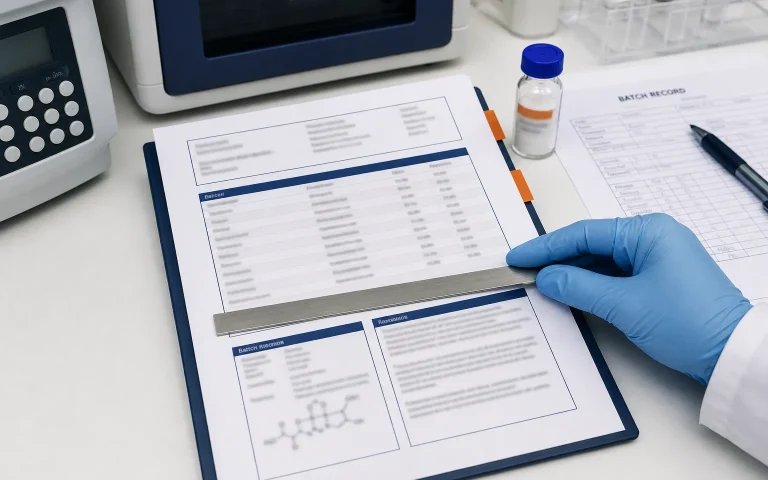
How to Read a Peptide COA: Batch Identity, Tests, Limits and Results
A field-by-field guide to batch identity, specifications, numerical results, dates, approval and the evidence a peptide COA still cannot supply.
ICH Q7 requirements plus FDA analytical-control guidance; not a review…Read the guide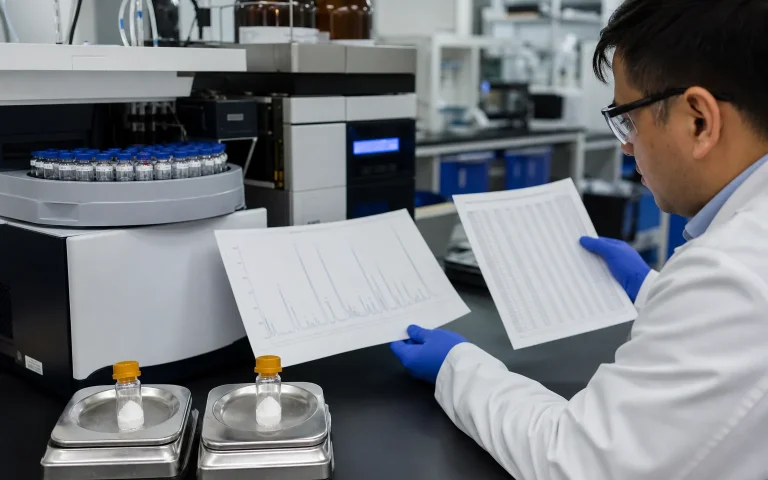
HPLC Area Purity vs Assay: Why a 99% Peak Is Not 99% Peptide Content
HPLC area percentage, assay and net peptide content answer different questions. Here is how detector response, water and counterions change interpretation.
ICH Q2(R2)/Q14 analytical principles and FDA synthetic-peptide guidance; no lot-specific…Read the guide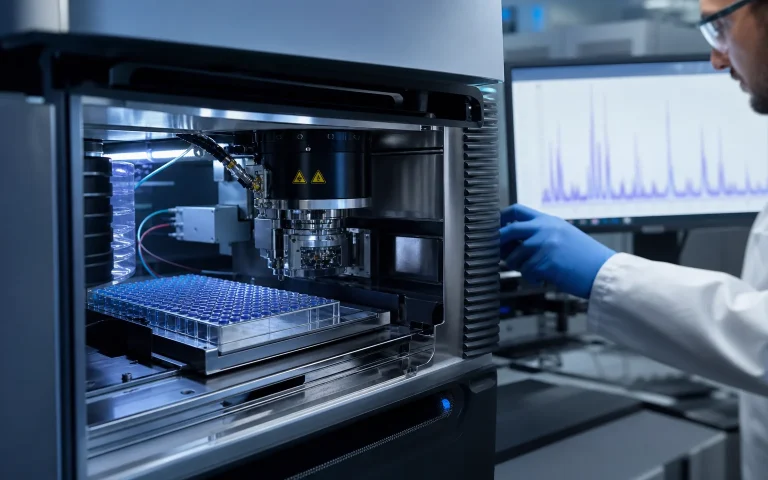
Reading LC-MS Peptide Identity: Exact Mass, Isotope Envelopes and MS/MS
A practical guide to charge states, deconvoluted mass, isotope envelopes and MS/MS sequence evidence—and why one matching mass is not complete identity proof.
ICH Q6B/FDA peptide-characterization principles plus peer-reviewed LC-MS methods; no lot-specific…Read the guide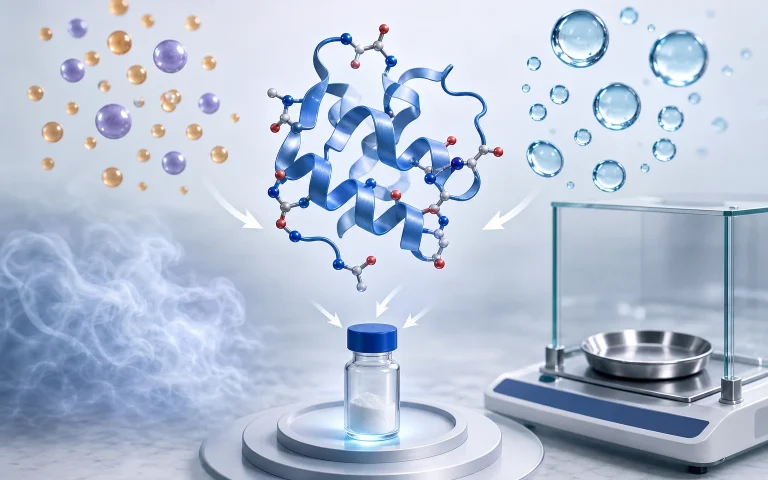
Peptide Counterions, Water and Residual Solvents: Interpreting Net Content
Why peptide powder mass can include counterions, water and residual solvents, how those components are measured, and how to avoid a false net-content claim.
ICH Q3C plus peer-reviewed counterion methods; numerical examples are hypotheticalRead the guide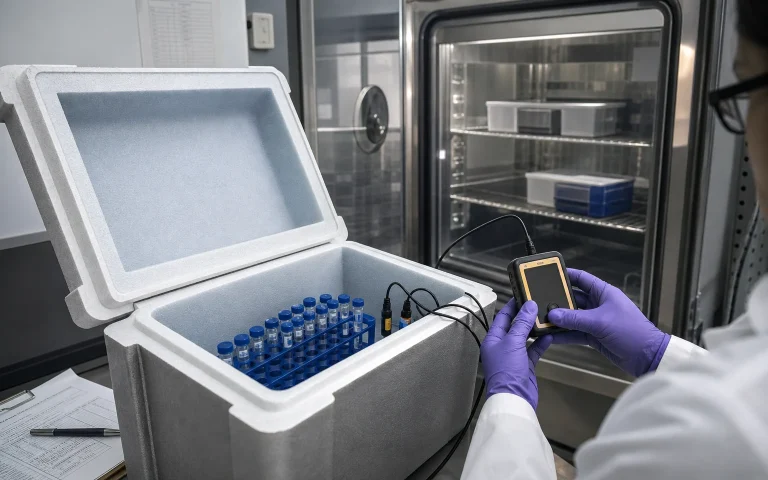
Peptide Storage vs Shipping Excursions: What Stability Data Can Actually Support
Storage labels, shipping conditions and temperature excursions are different claims. Learn what stability studies, packaging and lot records must support.
ICH Q1A(R2), Q7 and Q14 stability/analytical principles; no product-specific excursion…Read the guideDecision framework
Match each claim to the evidence that can support it
No single test is a complete product specification.
Exact or intact mass, isotope pattern, sequence/fragment evidence and an orthogonal identity method appropriate to the material.
Method, column, detection, integration rules, system suitability and the impurity peaks included in the reported area result.
Assay basis, water, counterions, residual solvents and other non-analyte mass needed to interpret how much target is present.
Batch-linked limits and results, packaging, retest/expiry basis, storage conditions and evidence for any shipping excursion.
Request checklist
What a useful lot document should let you verify
ICH Q7 describes a COA as a batch-specific document, not a generic marketing sheet. The checklist below is a procurement aid, not a claim that every item is currently available.
- Material name, form or grade
- Catalog identifier and batch/lot number
- Manufacturing or original-source traceability
- Test name and method reference
- Acceptance limit for each reported test
- Actual numerical result where applicable
- Release date plus retest or expiry basis
- Authorized quality-unit approval
Publication policy
What we will not infer
A published study cannot verify the identity, purity, storage or performance of a catalog batch.
A chromatographic area percentage is not automatically target mass fraction or peptide content.
A shipping practice does not establish shelf life without material-, package- and method-specific stability data.
Editorial images are labelled as illustrations and are not presented as photographs of a facility, product or instrument result.
Use the framework
Compare catalog families with the right questions ready.
Family pages show catalog variants and whether source review or document verification is complete.