Lot-document scope confirmed before quotation · Research use only
  • Specification Review
  • Lot Documents on Request
  • Business Support · Xi’an
  • Destination Eligibility Confirmed
西安诺和达生物科技有限公司

ANALYTICAL METHODS · PRACTICAL GUIDE

“Not Detected” Is Not Zero: Read Detection and Quantitation Limits

Learn what “not detected” tells you, and what number you still need.

NHD Technical Team3 teaching figuresSources checked: 2026-10-11

A report says “not detected.” Can you write that the sample contains none of that substance? Not quite. Every method has a limit to what it can see and measure. The report needs to tell you that limit.

Seeing something and measuring it accurately are different

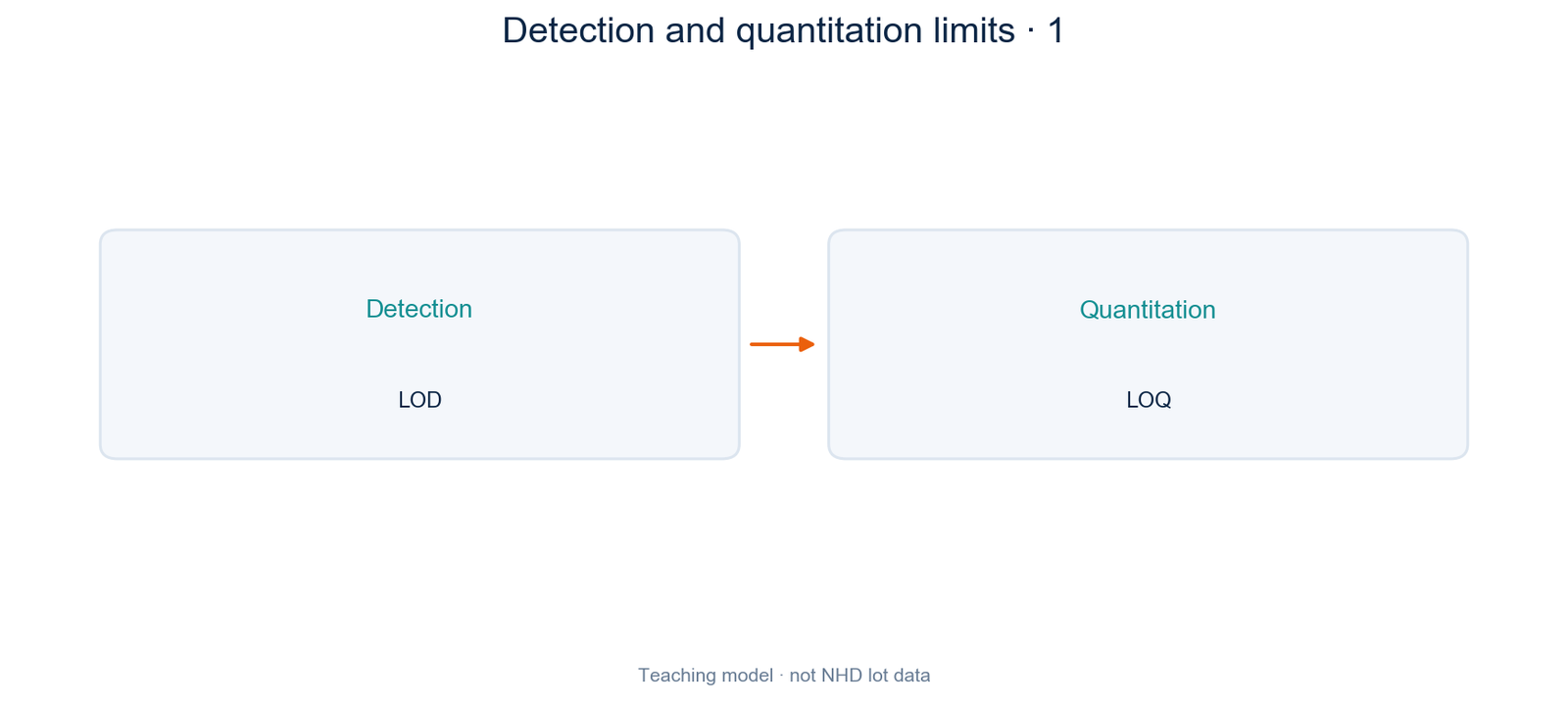
The detection limit concerns whether a low-level substance can be identified by the method. The quantitation limit concerns whether its amount can be measured with suitable performance. A faint signal may be recognizable before its quantity is reliable.

A reporting limit may be separately defined by the procedure. Ask which limit the report actually uses.
Detection and quantitation limits · 1
Figure 1. Detection and reliable quantity measurement answer different questions.

Follow one example from low to high

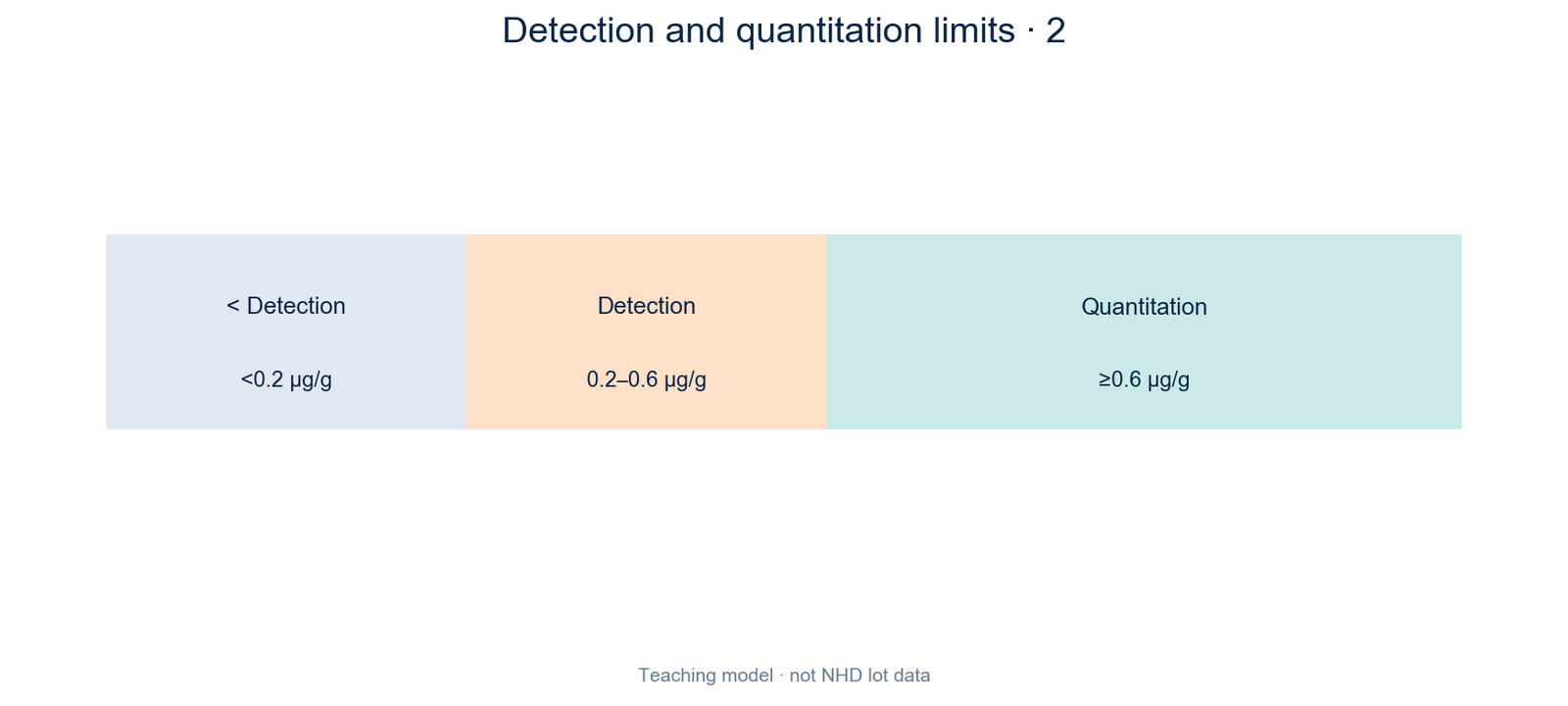
In this teaching example, the detection limit is about 0.2 µg/g and the quantitation limit is 0.6 µg/g. Below the detection capability, presence cannot be reliably established by these rules.

Above detection but below 0.6, there may be evidence of presence without a reliable numerical amount. In the established quantitative range, the method can support a quantity result.
Detection and quantitation limits · 2
Figure 2. Example detection and quantitation limits of 0.2 and 0.6 µg/g.

Does the limit answer your requirement?

Suppose you require less than 0.1 µg/g, but the result only supports less than 0.2 µg/g. It does not settle whether the sample meets the stricter requirement.

Both numbers may look small. The gap between them still matters. Compare the same substance, units and sample basis.

A blank box is not “not detected”

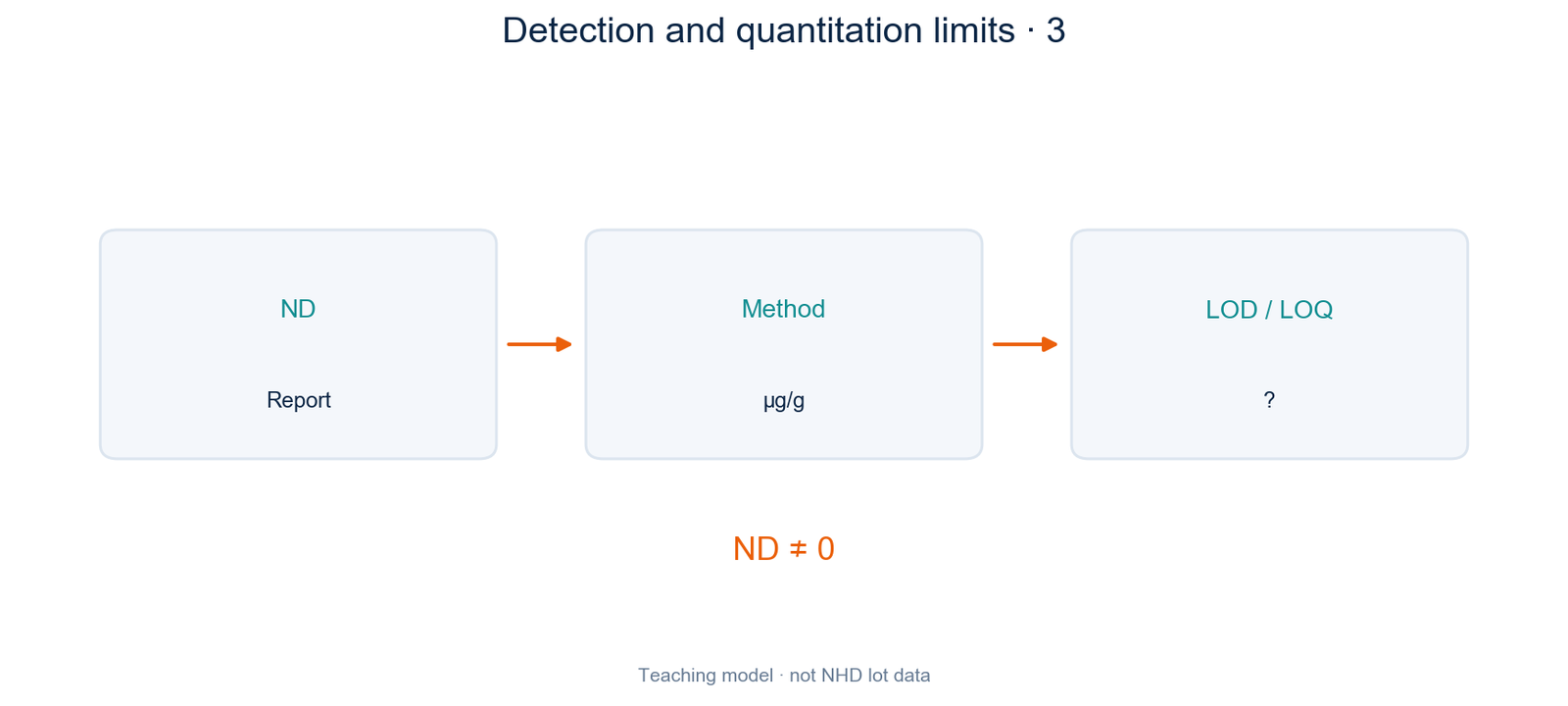
A blank field may mean no result was supplied. “Not tested” means the test was not performed. “Not detected” describes an outcome under a method’s reporting rules. None automatically means an exact zero.

A displayed 0.000 can also be rounded or processed. Ask how it was generated before treating it as an exact value.
Detection and quantitation limits · 3
Figure 3. Read “not detected” together with the method, unit and reporting limit.

Ask one complete question

Ask: which substance was tested, by which method, in what units, and with what reporting limit? Endotoxin and residual solvent tests, for example, investigate different substances.

A report states less than 1 µg/g. Does that establish less than 0.5 µg/g?

See the answer

No. The range from 0.5 to 1 µg/g has not been excluded.

Requesting results for LL-37 or GHK-Cu

For LL-37 or GHK-Cu, name the substance you want measured and the reporting capability you need. Confirm which tests were actually performed. HPLC purity does not provide an endotoxin result.

LL-37 / GHK-Cu

Discuss material and document requirements with NHD · Continue with the analytical guide
Sources and example notes

The numbers and curves are teaching examples, not product-batch test results. Sources checked on 11 October 2026.

AI-assisted writing and source review. Catalog materials are for research, development and manufacturing, not human or veterinary use.

Why “not detected” should not become zero in your spreadsheet

Not observing a reliable signal is different from proving complete absence. Keep the detection and quantitation limits with the result.

Think of a ruler with a smallest usable scale

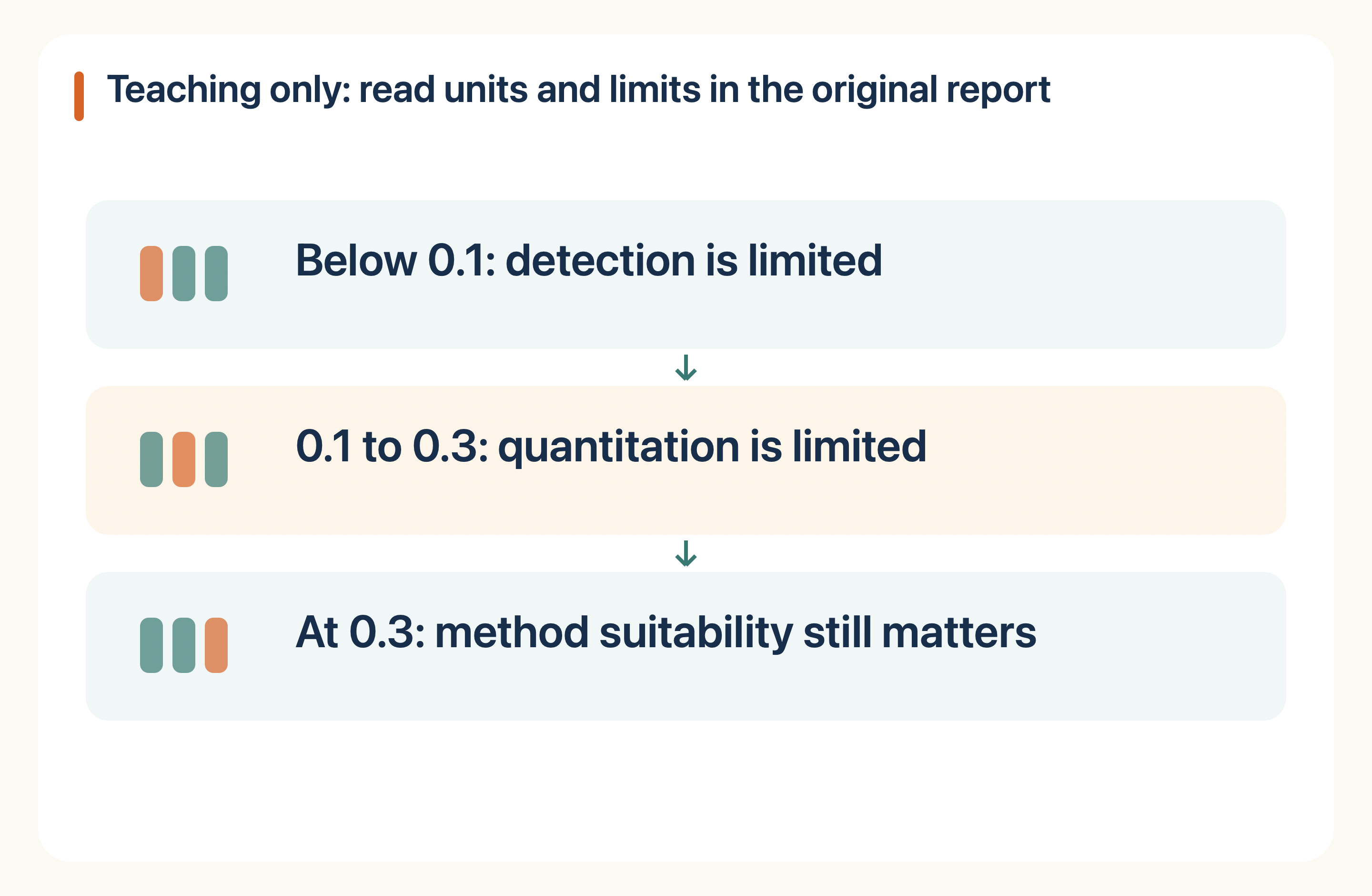
Hypothetical example: a method has a detection limit of 0.1 and a quantitation limit of 0.3 in the units specified by the report. Below the detection limit, presence cannot be reliably distinguished. Between the limits, a signal may be discernible without reliable quantitation. These numbers explain the concepts; they are not impurity acceptance limits.

Keep what the report actually means

Retain “not detected” with its detection limit. If the report says below the quantitation limit, retain the less-than sign and value. Converting both to zero changes subsequent averages, trend assessments and customer interpretation.

Teaching only: read units and limits in the original report
Teaching schematic. Numbers are hypothetical examples or explicitly identified study conditions described in the text.

Check dilution and units first

Does the limit apply to the measurement solution or has it been converted to the original sample? Was dilution included? Two “not detected” reports may have different detection capabilities without this context.

Original sources and scope

Consult the sources for full methods and results. Teaching examples are not NHD lot-test data.

Related research materials

Ask about materials and documentation

Research materials and experimental education; no instructions for human use.