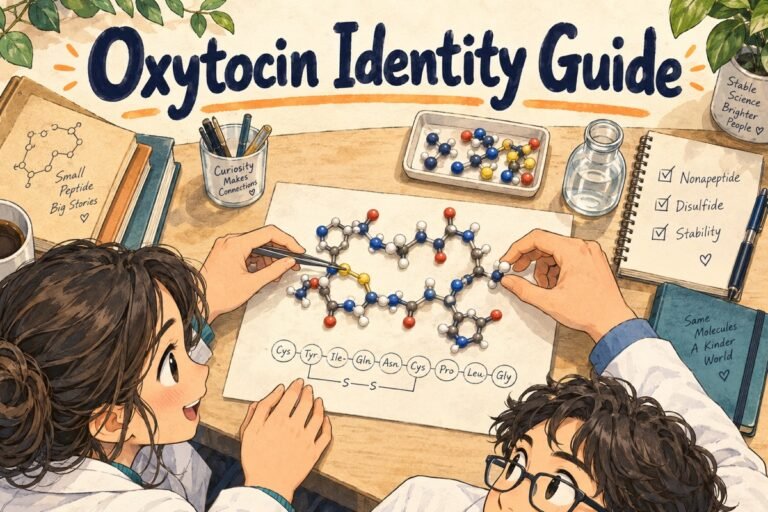
Two versions of a peptide can have the same amino-acid sequence but slightly different masses because a bond has formed inside the molecule. A disulfide bond is one example: under a simple oxidation model, forming one bond removes two hydrogen atoms.
What happens when the bond forms?
Two cysteine side chains can join through their sulfur atoms. Compared with the corresponding reduced thiols, the resulting disulfide contains two fewer hydrogen atoms. This explanation assumes a specified bond forms without other chemical changes; real samples can contain mixtures or additional modifications.
The calculated difference is about 2.016 Da
NIST gives the mass of a hydrogen-1 atom as 1.00782503223 Da. Removing two gives a calculated neutral monoisotopic mass change of −2.01565006446 Da. In a teaching example, a reduced peptide with neutral monoisotopic mass 2000.00000 Da would become approximately 1997.98435 Da after one such bond forms. These are illustrative numbers, not a measured batch.
Raw spectra may show a smaller gap
If both ions have charge +2, the corresponding m/z gap is approximately 1.007825. That is half the neutral mass difference. Comparing a neutral calculated mass directly with an unassigned raw ion peak can therefore create confusion even when the chemistry is understood.
Mass does not prove the bond arrangement
A mass consistent with one disulfide does not, by itself, identify which cysteines are connected when several are present. Bachem’s FAQ also distinguishes cysteine residues from a specifically requested disulfide arrangement. For an order, provide the intended cysteine pairing, not only the letters C in the sequence. Ask what evidence supports that arrangement, and whether a reduced comparison is needed for your particular investigation.
Next step with NHD
Start with the Disulfide peptide projects. For a quotation, send NHD your sequence or product name, quantity and required documents. Confirm the exact form, feasibility, available testing and delivery terms before ordering.
Sources
Public references explain the topic; they are not NHD batch evidence. Research materials are for laboratory research, development and manufacturing, not human or veterinary use.
Sources & editorial method
AI-assisted writing, source checks and illustrated cover.
2 linked records are listed in the references below. Read the editorial and AI-assistance policy.
How to interpret this article
Public data and labeled teaching calculations; not NHD batch results. Confirm project and document availability.
Research-use boundary: Catalog materials discussed on this website are for laboratory research, development and manufacturing use only, not for human or veterinary use. This content is not medical advice and does not provide administration instructions.
Primary records and authoritative sources
- NIST: hydrogen isotopic massesPublic reference, not NHD batch evidence.
- Bachem: peptide specification FAQPublic reference, not NHD batch evidence.
Continue with structured records
Move from this editorial analysis to the product identity, filtered evidence and controlled terminology behind it.