Lot-document scope confirmed before quotation · Research use only
  • Specification Review
  • Lot Documents on Request
  • Business Support · Xi’an
  • Destination Eligibility Confirmed
西安诺和达生物科技有限公司

ANALYTICAL METHODS · PRACTICAL GUIDE

Preparing a Peptide Stock: Calculate Mass and Final Volume

Calculate the amount you need for a stock solution, and understand why final volume matters.

NHD Technical Team3 teaching figuresSources checked: 2026-10-11

You want 10 mL of a 100 µM peptide stock. How much material do you need? The calculation uses three numbers: concentration, final volume and molecular weight. Let us work through them before discussing the powder and solvent.

Write down the three numbers first

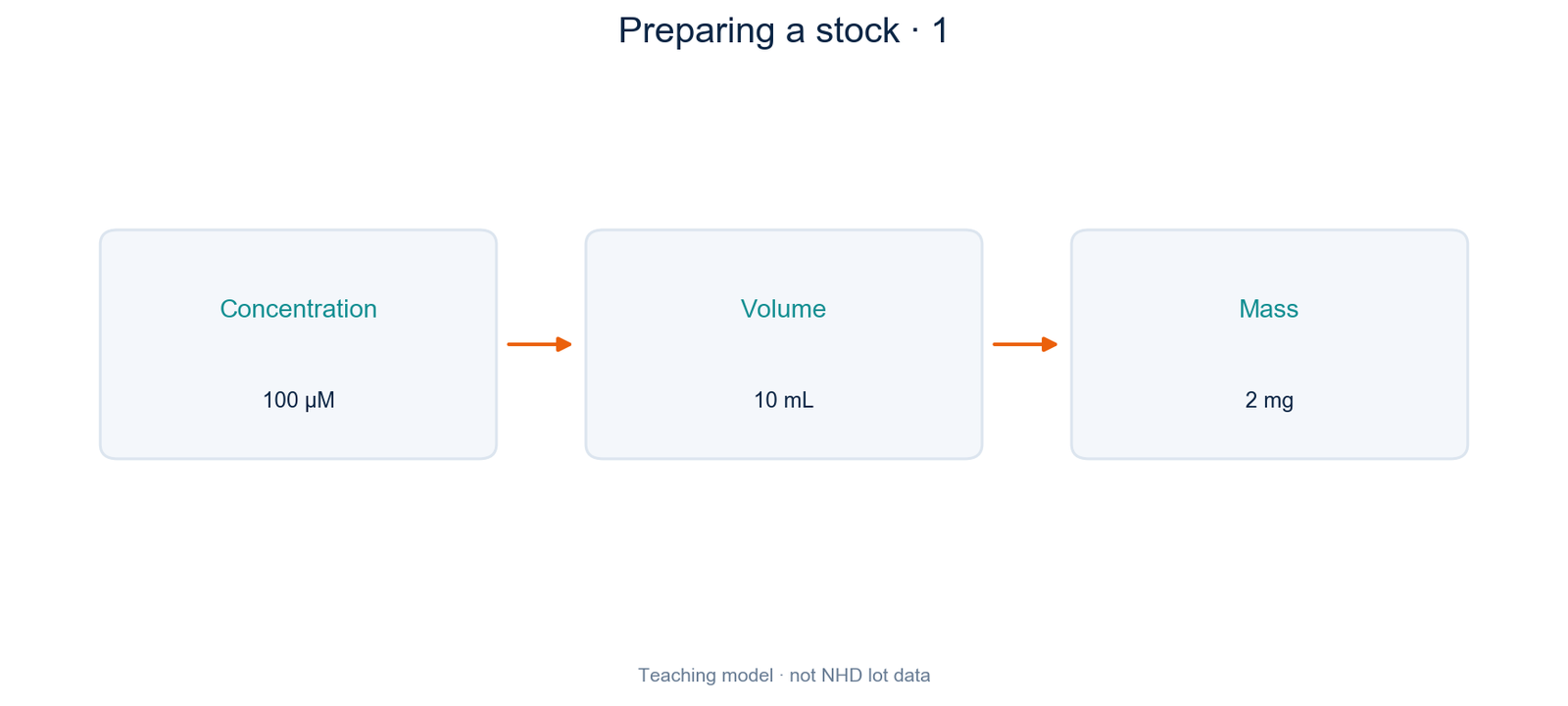
A stock solution is a relatively concentrated solution prepared for later dilution. In this example, the target is 100 µM, the final volume is 10 mL, and the molecular weight is 2,000 g/mol.

Convert the concentration to mol/L and the volume to litres: 100 µM = 0.0001 mol/L; 10 mL = 0.010 L.
Preparing a stock · 1
Figure 1. Start with concentration, final volume and molecular weight.

Calculate molecular amount, then mass

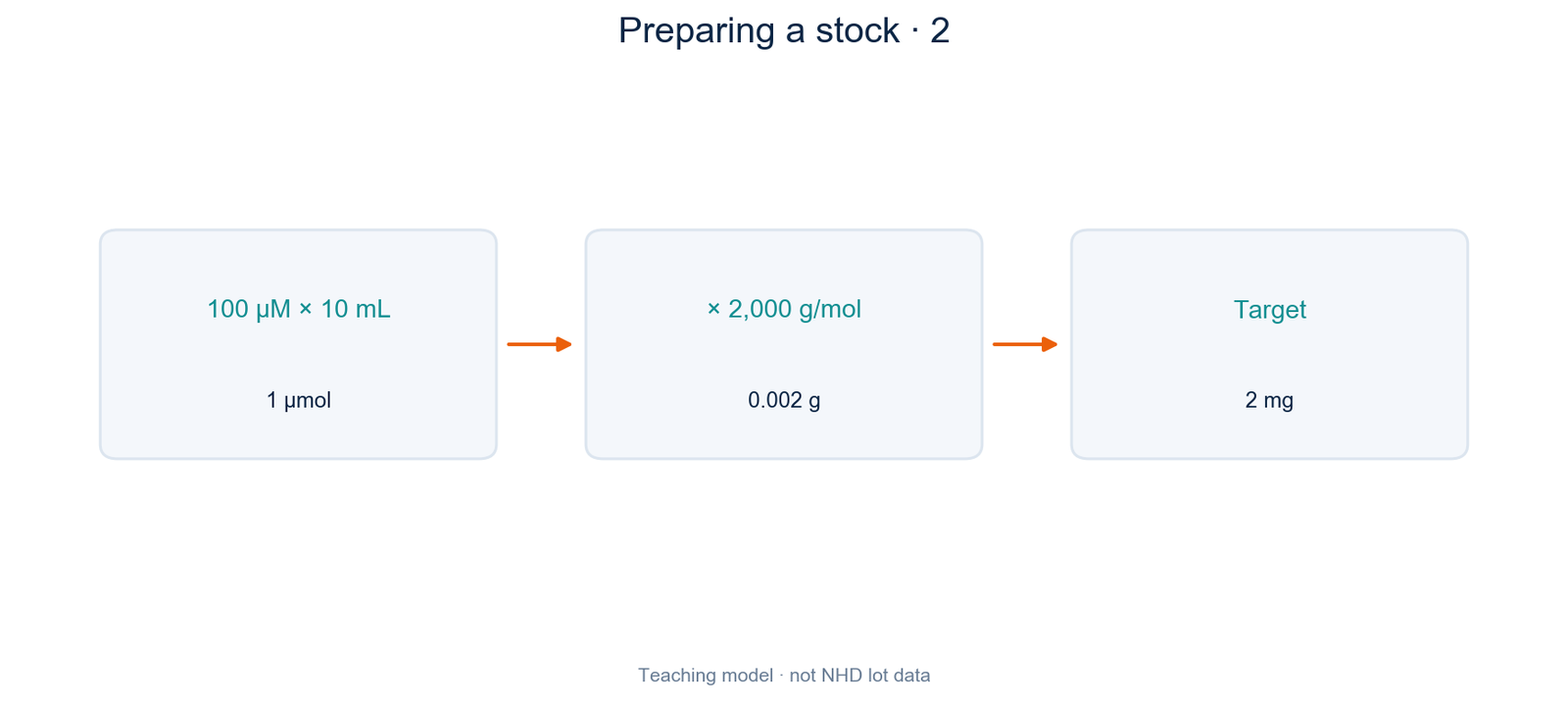
Multiply concentration by volume: 0.0001 × 0.010 = 0.000001 mol. Multiply that amount by 2,000 g/mol: the result is 0.002 g, or 2 mg.

The example therefore needs 2 mg of the specified peptide form, before any correction for other material in the powder.

0.0001 mol/L × 0.010 L × 2,000 g/mol = 0.002 g
Preparing a stock · 2
Figure 2. The example calculation gives 2 mg of target peptide.

What if only 80% of the powder is the target peptide?

Suppose a suitable quantitative test shows that the target peptide is 80% of the powder’s weight. To obtain 2 mg of target peptide, the powder amount is 2 ÷ 0.80 = 2.5 mg.

This requires a measured target-peptide mass fraction. An HPLC area-purity result of 98% cannot be substituted for it.

Preparing a stock · 3
Figure 3. A measured 80% target-peptide mass fraction would require 2.5 mg of powder.

“Make up to 10 mL” means final solution volume

Adding 10 mL of solvent and making a solution up to 10 mL describe different operations. The calculation above uses the final solution volume. Follow an appropriate preparation method that achieves that volume.

Before preparation, confirm a suitable solvent and handling conditions for the exact material. This arithmetic does not establish solubility.

Check the calculation with a smaller batch

With the same molecular weight, how much target peptide is needed for 5 mL at 100 µM?

See the answer

Half the volume needs half the amount: 1 mg of target peptide. If the measured target mass fraction is 80%, the powder amount would be 1.25 mg.

Record the mass weighed, molecular weight, final volume, solvent and any content correction. Another person should be able to follow the calculation without guessing.

Before preparing a MOTS-c or SS-31 stock

For MOTS-c or SS-31 stock planning, first confirm the exact material form and suitable solvent. Ask what quantity information is available for that material; do not assume the vial label is a measured target-peptide content result.

MOTS-c / SS-31

Discuss material and document requirements with NHD · Continue with the analytical guide

Preparing 2 mL of peptide stock: why not simply add 2 mL of solvent?

Keep the volume of solvent added separate from the final solution volume. A hypothetical preparation record shows why this matters for concentration.

Write the final volume before calculating mass

Hypothetical example: 2 mL at 1 mg/mL requires 2 mg of target peptide. Here, 1 mg/mL is defined by target peptide, not powder. If the powder contains water and salt, check how the report defines content. One milligram of powder is not automatically one milligram of target peptide.

Dissolve, then establish the final volume appropriately

When the calculation is based on final volume, dissolve the material in a suitable vessel and bring the solution to the planned final volume using an appropriate method. Adding 2 mL of solvent does not necessarily produce exactly 2 mL of solution. The preparation depends on sample amount, available measuring equipment and experimental requirements; rough vial markings are not enough.

Teaching calculation: distinguish powder mass from target peptide mass
Teaching schematic. Numbers are hypothetical examples or explicitly identified study conditions described in the text.

Keep four numbers in the record

Record actual mass used, the basis of that mass, final volume and preparation concentration. If content correction was applied, record its source and lot. A later discrepancy can then be traced to arithmetic, measurement or different definitions of material amount.

Use the calculation when planning an order

For KPV or BPC-157, list the concentration and final volume needed for each experiment before estimating material quantity. Product pages help identify materials and specifications. The hypothetical 2 mg is neither a measured product content nor a use recommendation.

Original sources and scope

Consult the sources for full methods and results. Teaching examples are not NHD lot-test data.

Related research materials

Ask about materials and documentation

Research materials and experimental education; no instructions for human use.