


ANALYTICAL METHODS · PRACTICAL GUIDE
Diluting a Peptide Stock? Count the Final DMSO Percentage
Track how much DMSO enters the final mixture when you dilute a peptide stock.
A small addition of a concentrated peptide stock also adds its solvent. If the stock contains DMSO, you need to track that liquid as well as the peptide. The two calculations answer different questions.
Count the solvent volume first
DMSO is a solvent sometimes used in research stock solutions. To calculate its final volume percentage, find how many microlitres of DMSO were added, then divide by the final mixture volume.
A stock made in pure DMSO contributes one microlitre of DMSO per microlitre transferred. A stock containing 20% DMSO contributes less.
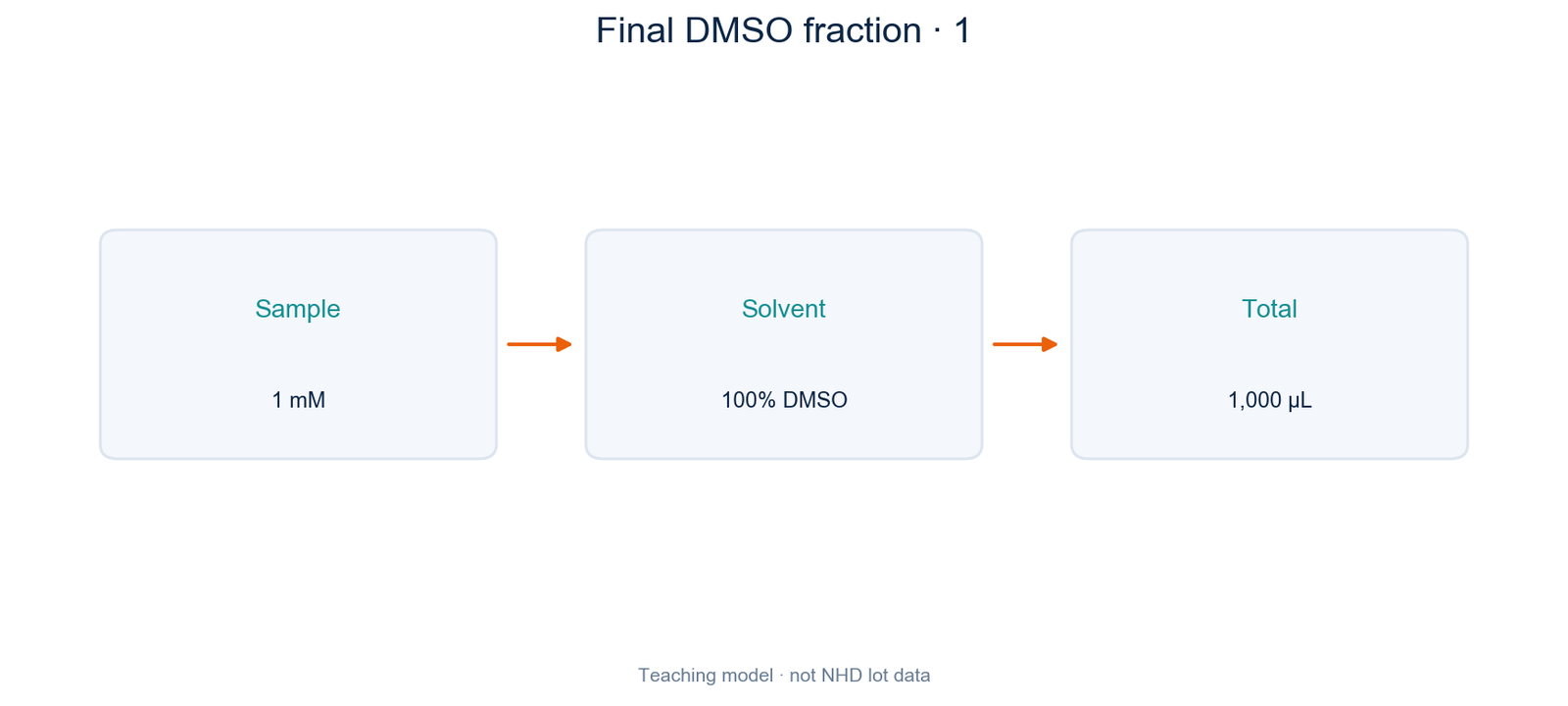
An example with pure DMSO
Assume a 1 mM peptide stock in pure DMSO. Transfer 10 µL and make the final mixture up to 1,000 µL. The peptide concentration is 1,000 µM × 10 ÷ 1,000 = 10 µM.
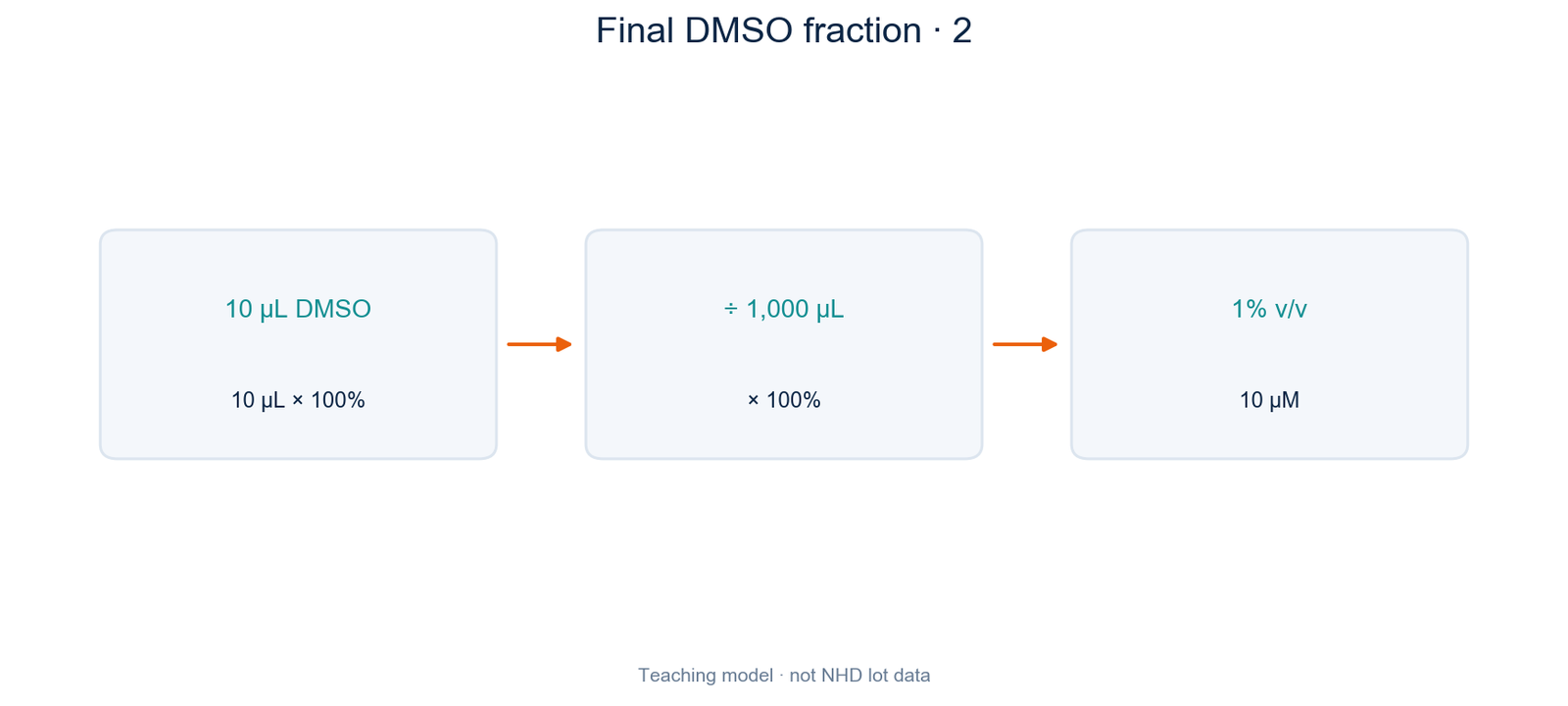
The DMSO percentage is 10 ÷ 1,000 × 100% = 1% by volume. These numbers describe the same mixture, but one describes peptide concentration and the other solvent proportion.
10 µL DMSO ÷ 1,000 µL final volume × 100% = 1%
What changes if the stock contains 20% DMSO?
The same 10 µL aliquot now carries 10 × 0.20 = 2 µL of DMSO. In a final 1,000 µL mixture, that is 0.2% by volume.
If several reagents contain DMSO, add all their DMSO contributions before dividing by the final volume. Do not count only the peptide stock.
Why a solvent control matters
If wells receive different stock volumes, their DMSO percentages can differ too. A suitable solvent control helps you investigate the solvent contribution instead of attributing every change to the peptide.
Whether a particular percentage is acceptable depends on the research system. The 1% and 0.2% here are calculations, not recommended limits.

Try an aliquot of a mixed-solvent stock
See the answer
The aliquot contains 5 × 0.40 = 2 µL of DMSO. The final percentage is 2 ÷ 1,000 × 100% = 0.2% by volume.
Write the stock solvent composition and final volume next to the calculation. A stock volume alone is not enough to reproduce it.
Check the solvent when planning LL-37 or SS-31 work
For LL-37 or SS-31, confirm which solvent is suitable for the supplied material. Then calculate what that solvent contributes to your planned final mixture. A product name does not establish a universal DMSO preparation method.
Discuss material and document requirements with NHD · Continue with the analytical guide