


ANALYTICAL METHODS · PRACTICAL GUIDE
Peptide Mass Error: Why 0.01 Da Can Mean Different ppm Values
Turn a mass difference into ppm, then check which masses were compared.
The measured mass is 0.01 Da above the expected mass. Is that close? It depends on the size of the molecule. ppm expresses the difference relative to the expected mass, rather than just in daltons.
Da gives the difference; ppm gives its proportion
Da, or dalton, is a molecular mass unit. A difference of 0.01 Da is an absolute difference. ppm means parts per million: here it describes the mass difference as a fraction of the reference mass, multiplied by one million.
The formula is: ppm error = (measured mass − reference mass) ÷ reference mass × 1,000,000.

Work through a 1,000 Da example
The reference is 1,000.0000 Da and the measured value is 1,000.0100 Da. Subtraction gives +0.0100 Da. Divide by 1,000 and multiply by one million: +10 ppm.
The plus sign means the measurement is higher. A measured value of 999.9900 Da would instead give −10 ppm.

Use the same difference with a heavier molecule
At a reference mass of 5,000 Da, a +0.01 Da difference is +2 ppm. The same absolute difference occupies a smaller share of the larger molecule’s mass.
That is why “the masses differ by 0.01 Da” is incomplete when you want to compare relative errors.
Make sure you subtract like from like
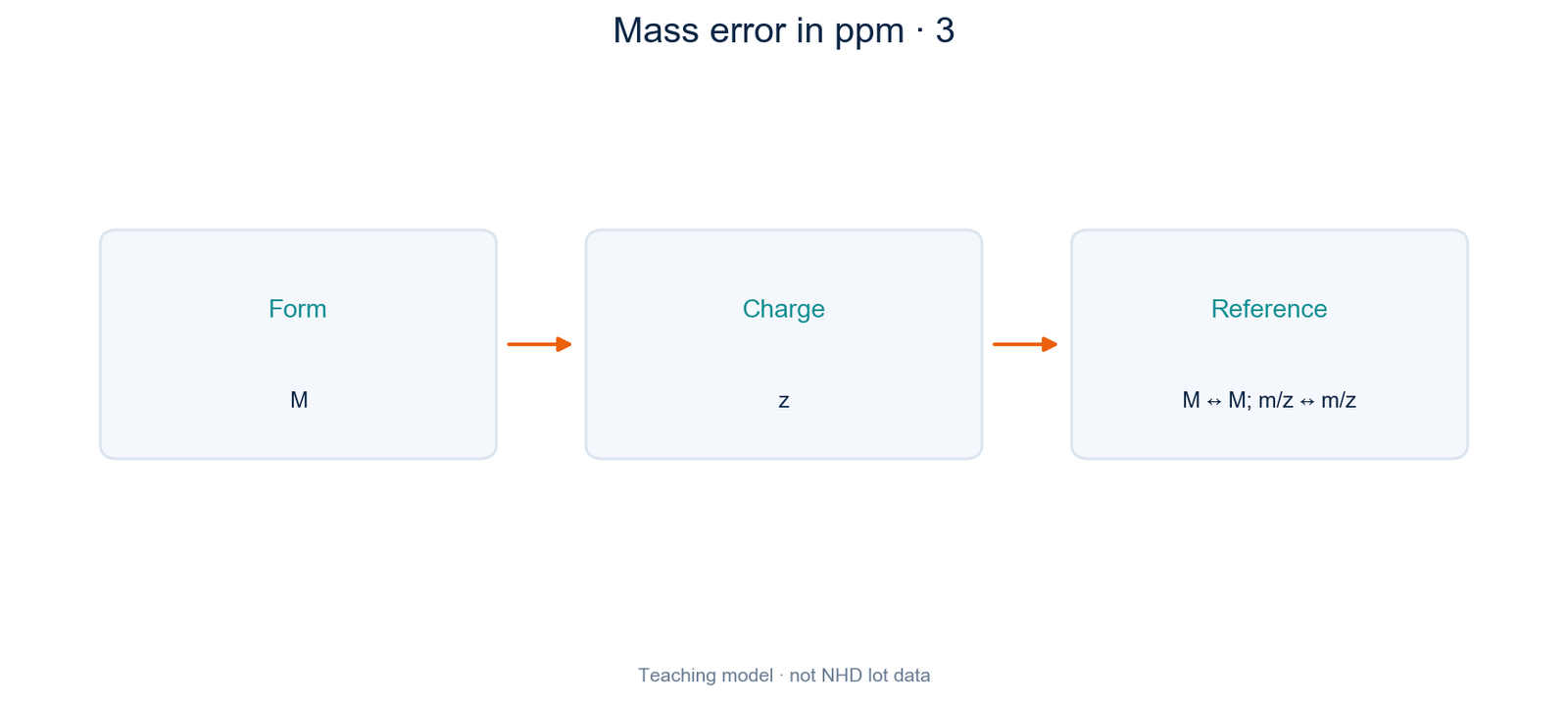
A mass-spectrum axis often shows m/z, meaning ion mass divided by charge. Do not subtract that directly from a neutral molecular mass. Also check whether the reference uses monoisotopic mass or average mass; these are different ways of describing molecular mass.
The expected product form, modifications and ion assignment also need to match. A small error supports a mass match but does not prove the entire sequence or biological activity.
Try another pair of values
Keep enough decimal places during the calculation, then round the final result. Whether it is acceptable depends on the method and the question being tested.
See the answer
+0.0060 ÷ 2,000 × 1,000,000 = +3 ppm.
Checking a MOTS-c or SS-31 mass result
For MOTS-c or SS-31, use the reference mass for the exact supplied form. Ask which mass type and ions were used in the comparison, so the ppm calculation starts from matching values.
Discuss material and document requirements with NHD · Continue with the analytical guide